
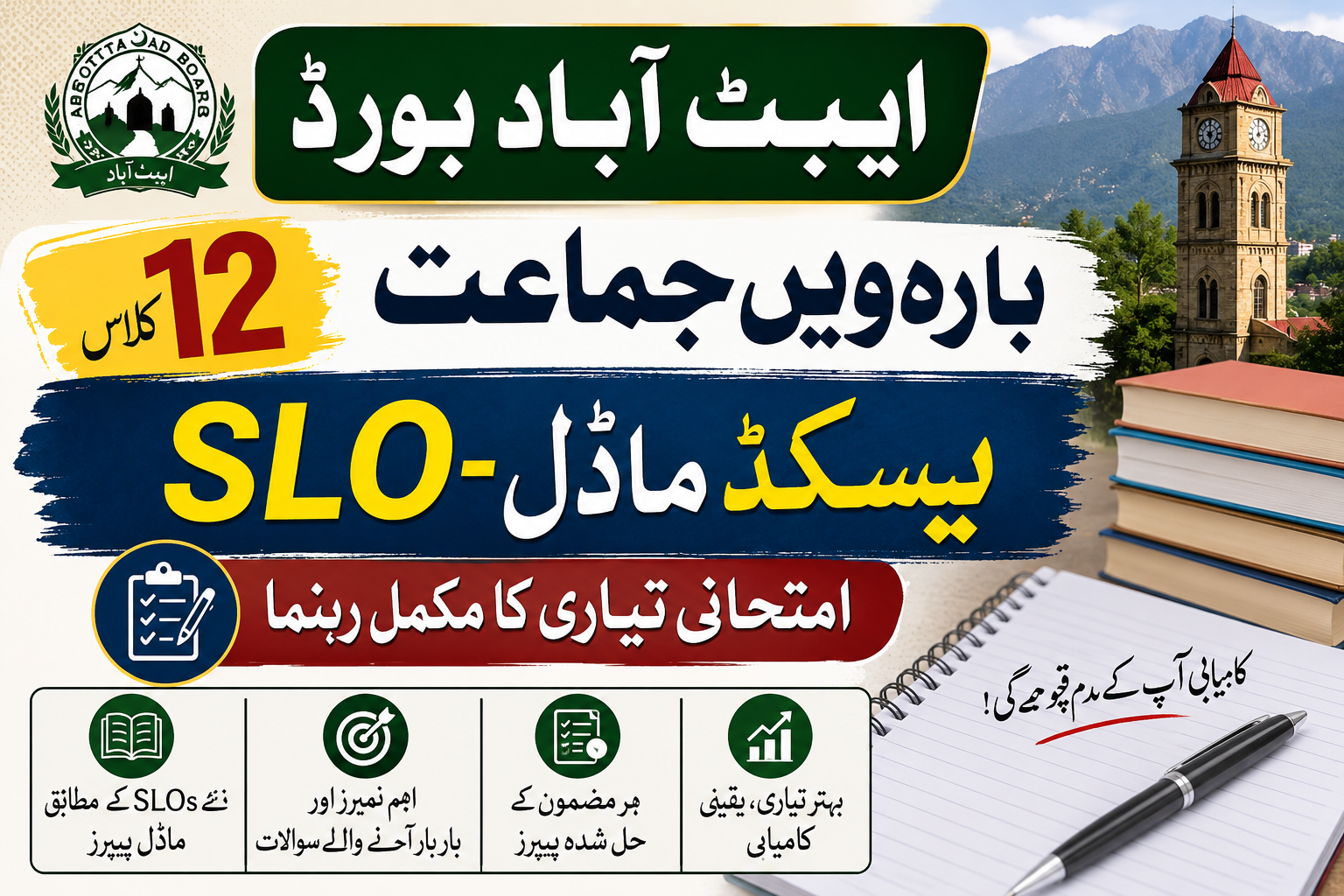
Preparing for the Higher Secondary School Certificate (HSSC) Part-II examinations under the Board of Intermediate and Secondary Education (BISE) Abbottabad requires a strategic approach. With educational boards shifting focus toward Student Learning Outcome (SLO) based assessments, rote memorization is no longer sufficient to secure top marks. Students must understand conceptual frameworks, critical thinking requirements, and structured marking schemes. This comprehensive guide explores the official SLO-based model papers, marking schemes, and tables of specification provided by BISE Abbottabad for 12th-grade students across key subjects like Biology, Chemistry, Physics, Mathematics, English, Pakistan Studies, and Urdu.
Understanding the Shift to SLO-Based Assessments
The traditional examination structure heavily rewarded the memorization of textbook paragraphs. However, modern educational reforms implemented across educational boards prioritize conceptual clarity and practical application. SLO-based model papers released by BISE Abbottabad are engineered to test a student’s true comprehension of core concepts.
When candidates review these model papers, they encounter analytical questions, scenario-based problems, and application-oriented queries. Preparing with these blueprints allows students to align their study habits with the expectations of examiners, reducing anxiety and boosting confidence ahead of the annual board examinations.
Subject-Wise Breakdown of BISE Abbottabad Model Papers
BISE Abbottabad provides dedicated resources for each subject, typically comprising three core downloadable components: the model question paper, the official marking scheme, and the table of specification.
Science Group Subjects: Biology, Chemistry, and Physics
For science students, conceptual depth is mandatory for high-tier university admissions in medical and engineering fields.
- Biology: The biology model paper and its corresponding marking scheme emphasize physiological processes, cellular mechanisms, and diagrammatic interpretation. Students must practice labeling precise structures and explaining biological pathways logically.
- Chemistry: The chemistry resources highlight chemical equations, stoichiometric calculations, and organic reaction mechanisms. The marking scheme clarifies how step-by-step working awards partial credit during evaluations.
- Physics: Physics model papers test numerical problem-solving alongside theoretical derivations. Understanding core principles in electromagnetism, modern physics, and mechanics is critical to handling application-based prompts.
Core Analytical and Language Disciplines: Mathematics, English, and Urdu
Language proficiency and mathematical reasoning form the backbone of overall academic scoring.
- Mathematics: The mathematics model paper and marking scheme test logical deduction, calculus, algebra, and coordinate geometry. Examiners look for clean step-by-step derivations rather than final answers alone.
- English: The English model paper evaluates linguistic competence, comprehension, grammar application, and creative writing. Standardized marking schemes outline strict rubrics for syntax, vocabulary, and structural coherence.
- Urdu: As a core language paper, the Urdu model framework tests prose analysis, poetry explanation (Ashaar ki Tashreeh), grammar, and compositional writing, requiring precise adherence to literary standards.
Compulsory Subject: Pakistan Studies
Pakistan Studies bridges historical awareness with civic responsibility. The model paper and specification table guide students on how to structure chronological arguments, constitutional developments, and geopolitical analyses effectively.
The Role of Marking Schemes and Tables of Specification
A common pitfall among intermediate students is studying hard without studying smart. Accessing the official marking schemes and tables of specification provides a distinct competitive advantage.
- Marking Schemes: These documents reveal exactly how examiners distribute points across different sections of a question. Knowing that a multi-part question awards specific marks for formula application, intermediate calculation steps, and final units prevents avoidable point losses.
- Tables of Specification: These blueprints outline the weightage of various chapters and cognitive levels (such as knowledge, comprehension, and application). Students can prioritize high-yield topics and manage their revision schedules efficiently.
Actionable Strategies for Effective Exam Preparation
Maximizing the utility of BISE Abbottabad’s 12th-grade model papers involves a disciplined implementation strategy:
- Simulate Exam Conditions: Attempt the model papers within the allotted board examination time limits without referring to textbooks. This builds crucial time-management skills.
- Self-Evaluation via Marking Schemes: Compare your written answers directly against the official marking schemes to identify recurring weaknesses in terminology or structural presentation.
- Targeted Revision: Use the table of specification to pinpoint chapters that carry higher cognitive weight and dedicate extra study hours to mastering those domains.
- Consistent Practice: Regular problem-solving in quantitative subjects and timed essay practice in language papers will bridge the gap between theoretical knowledge and top-tier board performance.
For further updates, model papers, and official educational resources, stay connected with our platform at biseatd.com.

