
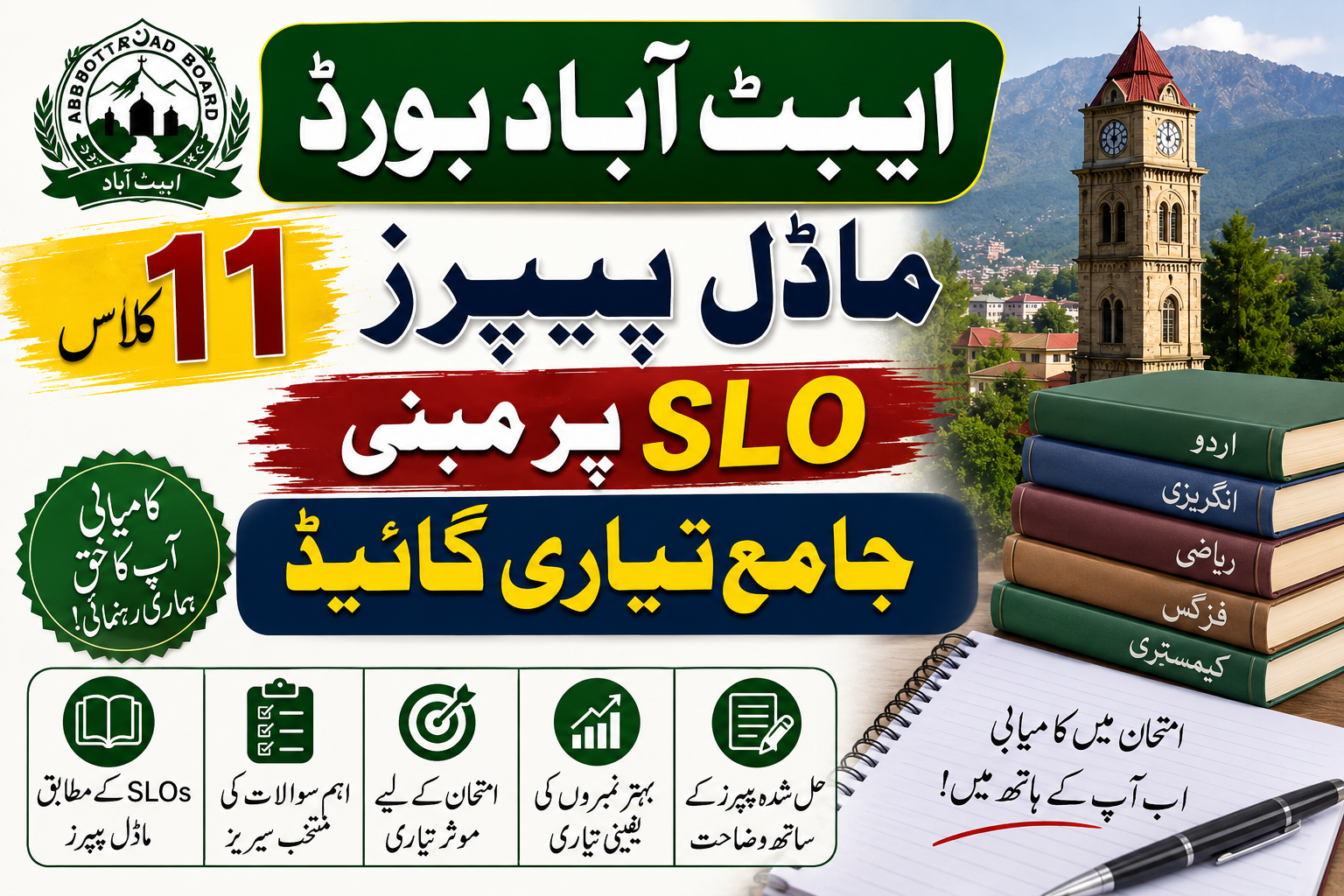
Navigating the transition from high school to intermediate education presents unique challenges for students across Pakistan. For candidates enrolled under the Board of Intermediate and Secondary Education (BISE) Abbottabad, preparing for the Higher Secondary School Certificate (HSSC) Part-I examinations requires moving beyond traditional rote memorization. With educational boards fully implementing Student Learning Outcome (SLO) based curricula, understanding conceptual frameworks, structured marking schemes, and blueprint specifications is essential. This comprehensive guide reviews the official SLO-based model papers, marking schemes, and tables of specification provided by BISE Abbottabad for 11th-grade subjects including Biology, Chemistry, Computer Science, English, Islamiyat, Mathematics, Physics, and Urdu.
The Paradigm Shift to SLO-Based Examinations
Traditional testing methodologies heavily favored textbook repetition and memorization. However, modern educational reforms prioritize analytical reasoning, critical thinking, and the practical application of core scientific and linguistic concepts. The SLO-based model papers released by BISE Abbottabad serve as official blueprints designed to reflect this modern evaluation style.
When students review these model papers, they encounter scenario-based questions and conceptual problems that test true comprehension rather than recall. Utilizing these resources allows candidates to align their study habits directly with examiner expectations, alleviating exam anxiety and fostering deeper academic confidence.
Subject-Wise Breakdown of BISE Abbottabad 11th Class Model Papers
BISE Abbottabad provides dedicated resources for each discipline, typically featuring three core downloadable components: the model question paper, the official marking scheme, and the table of specification.
Science Group: Biology, Chemistry, Physics, and Computer Science
For science and pre-engineering or pre-medical candidates, mastering analytical problem-solving is critical.
- Biology: The biology model paper and its corresponding marking scheme emphasize cellular structures, biological molecules, and physiological processes, requiring precise diagrammatic interpretation and conceptual explanation.
- Chemistry: Chemistry resources focus on atomic structures, chemical bonding, stoichiometry, and thermochemistry, where step-by-step calculations determine success.
- Physics: Physics model papers evaluate a student’s grasp of vectors, motion, work-energy principles, and thermodynamics through a blend of theoretical derivations and numerical problems.
- Computer Science: The computer science curriculum bridges hardware logic, programming fundamentals, and algorithmic problem-solving, testing technical logic via structured questions.
Core Disciplines: Mathematics, English, Urdu, and Islamiyat
Language proficiency, quantitative logic, and foundational Islamic studies form the mandatory core of intermediate education.
- Mathematics: The mathematics model framework challenges students with advanced algebra, trigonometry, and analytical geometry, rewarding methodical step-by-step derivations.
- English: The English model paper and marking scheme test reading comprehension, grammatical application, structural coherence, and literary analysis based on strict evaluation rubrics.
- Urdu: The Urdu model resources assess prose interpretation, poetry explanation (Ashaar ki Tashreeh), and grammatical composition according to standardized literary parameters.
- Islamiyat: Compulsory Islamic studies papers evaluate ideological concepts, historical context, and textual comprehension with clarity and depth.
Structuring Success Through Marking Schemes and Tables of Specification
A common pitfall among intermediate students is putting in long study hours without a targeted strategy. Accessing the accompanying marking schemes and tables of specification provides a distinct structural advantage.
- Marking Schemes: These official guides reveal precisely how examiners distribute points across multi-part questions, highlighting the importance of formula application, intermediate steps, and appropriate scientific or linguistic terminology.
- Tables of Specification: These blueprints outline the cognitive weightage and chapter-wise distribution of exam questions, enabling students to prioritize high-yield areas during revision.
Actionable Strategies for Effective Exam Preparation
Maximizing the utility of BISE Abbottabad’s 11th-grade model papers requires a disciplined, step-by-step implementation strategy:
- Simulate Exam Conditions: Attempt the model papers within standard board time limits and without textbook assistance to build reliable time-management skills.
- Self-Evaluate Rigorously: Compare completed answers directly against the official marking schemes to uncover recurring vulnerabilities in technical notation or structural presentation.
- Prioritize Strategic Revision: Use the tables of specification to identify high-weightage topics and dedicate extra study hours toward mastering those concepts.
- Consistent Practice: Regular numerical problem-solving in science subjects and timed essay drills in language papers bridge the gap between passive reading and top-tier performance.
For further updates about 11th SLO-Based Model Papers, or other educational info, stay connected with our platform at biseatd.com.
Here are the Frequently Asked Questions (FAQs) regarding date sheet schedules, practical exams, and improvement exam policies in clear, structured English:
1. Practical Examination Schedules & Coordination
- Q: Why does the current practical exam schedule cause confusion among students and schools?
- A: Overlapping or unclear date sheets leave students uncertain about their specific exam days. This forces them to make frequent inquiry calls or travel to school unnecessarily just to check if they have a practical scheduled.
- Q: What is the recommended practical exam schedule for 1st-year and 2nd-year classes?
- A: Board authorities should implement an alternating schedule: dedicate one full day exclusively to 1st-year practicals and the following day to 2nd-year practicals. This clear separation eliminates confusion and prevents unnecessary travel.
2. Improvement Candidates & Timetable Spacing
- Q: Why is the prolonged exam duration a problem for mark improvement candidates?
- A: Students appearing for mark improvement often face excessively long gaps between individual papers. This unnecessarily extends their total examination period, causing prolonged stress, academic fatigue, and disruption to their study routine.
- Q: How can board administrators improve the schedule for improvement students?
- A: Date sheet planners should balance the spacing between papers so that improvement candidates are not forced to wait several days or weeks for a single remaining exam.
3. Administrative Impact & Student Guidance
- Q: How does poor date sheet planning impact school administration?
- A: Unclear exam schedules result in school administration offices being flooded with phone calls and visits from anxious students and parents seeking confirmation on timetable details.
- Q: What steps should students take if their exam timetable is unclear?
- A: Students should verify their roll number slips via the official BISE portal, contact their school administration directly, or reach out to the board helpline for official confirmation.

